Thursday, June 4, 2015


Wednesday, December 10, 2014


Saturday, October 25, 2014
BAU germplasm center Bangladesh
The centre is the second largest of its kind,
the largest being Miami Germplasm Centre in Florida in the United States of
America
The Germplasm Centre
at the Bangladesh Agriculture University (BAU) has so far released more than 70
varieties of fruit as scientists work incessantly to bring about a ‘fruit
revolution’ in the country.
The Centre was set up
in 1991at the university under a ‘Fruit Tree Improvement Project’ with
financial aid from the Swiss Agency for Development and Cooperation (SDC) and
Danish International Development Agency (DANIDA). Professor Dr M A Rahim, an
eminent scientist of the Horticulture department of BAU heads the Germplasm
Centre as its Director since its establishment.
The centre is the
second largest of its kind, the largest being Miami Germplasm Centre in Florida
in the United States of America.
Among the huge
collection of rare fruit trees, there are almost 11,245 mother trees of 688
varieties of 175 fruit species in the centre under four categories, viz
domestic major and minor fruits (including endangered fruits), foreign and
medicinal fruits.
The country’s popular
BAU-Kul is one of the species that was developed at the centre. Other
registered fruits released from the centre were about 17 varieties of mango, 10
varities of guava, five varities of lime, four varities of lychee, three
varieties of kul, carambola (kamranga), wax apple (jamrul), dragon fruit, lemon
and sofeda (sapodilla), two varieties of longan (lakta) and tamarind, and one
variety of olive, amlaki, lotkan, fig, malta, wood apple (kadbel), country
gooseberry (orboroi), strawberry, almond, jackfruit, plum and rambutan.
The centre has also
released three varieties of garlic, two of carrots, one of sweet pumpkin and
six varieties of potato, Germplasm sources said.
Germplasm Centre has
signed Memorandum of Understanding (MoU) with many government institutions,
NGOs and foreign institutions to spread the technology as well develop fruit
trees for the root level farmers and nurseries.
It offers training to
nursery cultivators, farmers and NGO workers to improve their skills in
commercial fruit cultivation in the country. Superior quality saplings are sold
to people at cheap rate to spread these fruit varieties across the country.
US Ambassador to
Bangladesh, Dan W Mozena visited the Germplasm Centre on July 17, 2012 and
expressed his satisfaction over its development work.
Talking to the Dhaka
Tribune about the foundation of Asia’s largest Germplasm Centre, its Director
Prof Rahim said that he started research on fruits from the inception of his
teaching career at BAU. He has brought rare varieties of fruit-seeds from the
various countries he had visited and tried to grow them at the Germplasm
Centre. He also collected many local fruit varieties including endangered ones
for research, development and conservation in the ‘live fruit museum.’
They were able to
release the 70 fruit varieties and a few varieties of vegetable so far as a
number of students.


Wednesday, October 22, 2014


Monday, September 22, 2014
Bangladesh Guava
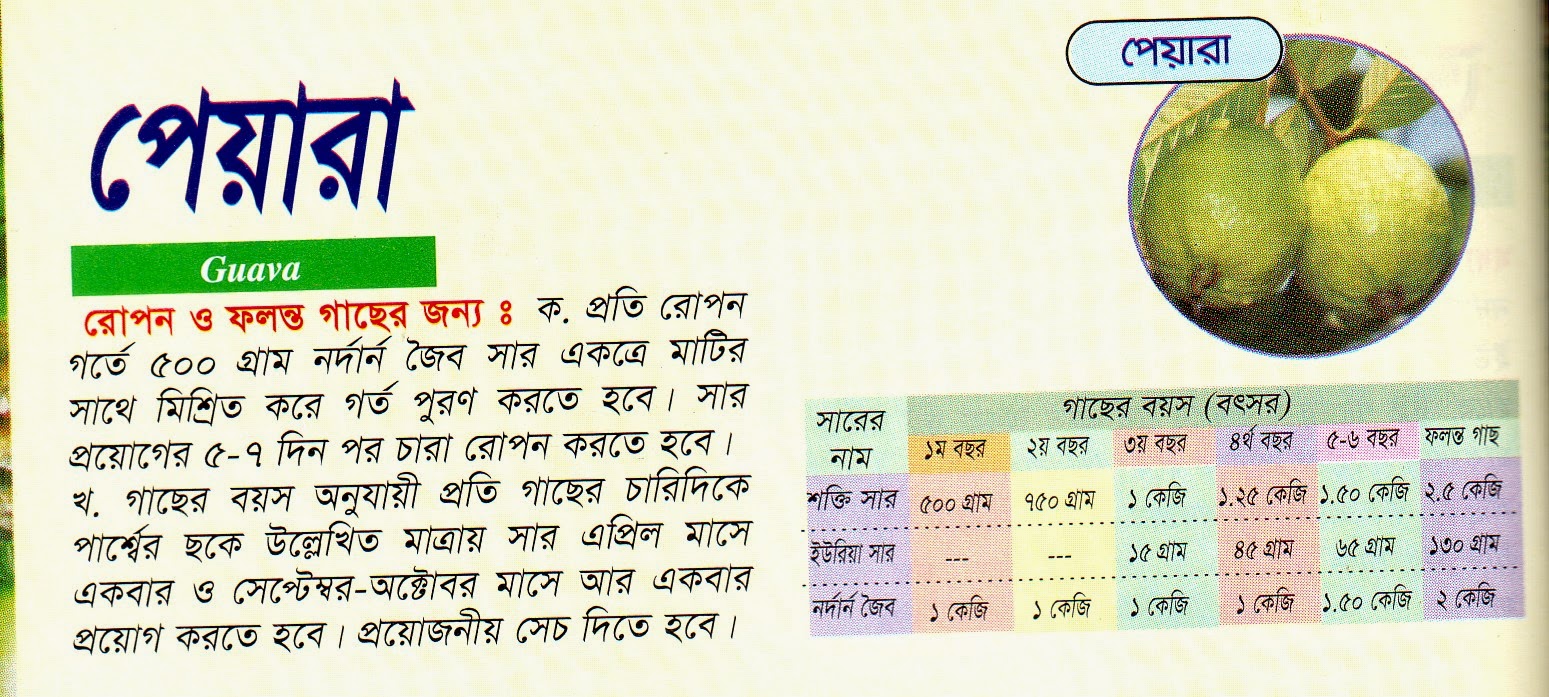

Guava (payara)
a berry like fruit of any of various myrtaceous trees or shrubs of the genus Psidium, especially P. guajava (family Myrtaceae). It originated in
tropical America (Mexico to Peru), where it still occurs in the wild. Guava is
often called the "apple of the tropics". The plant was introduced by
the portuguese to the Indian subcontinent by the
early 17th century. Guava stands fifth in production among the most important
fruit crops of Bangladesh and can be grown all over the country. The annual
production is about 45,000 m tons in an area of about 10,000 ha. The districts
of Barisal, Pirojpur, Jhalokathi, and Chittagong are the main guava producing
areas. Some of the important varieties are known by the name of the places
where these are grown commercially. Thus Swarupkathi is from Barisal,
Mukundapuri from Brahmanbaria and Kanchannagar from Chittagong.
Kazi, introduced from Thailand, is the only standard variety
that has been released by the Bangladesh Agricultural Research Institute. It
produces fruits weighing up to 500 g or even more. All the other varieties have
fruit weights ranging from 100 to 200 g; can be propagated by seed, stem
cutting, budding, grafting and air layering. Mobile -01713479525
https://www.facebook.com/organic.fertilizer.bangladesh
https://www.facebook.com/organic.fertilizer.bangladesh
Wednesday, September 17, 2014
investment agriculture sector bangladesh
Rice Cultivation
Tomatoes and Pepper Cultivation
Vegetable Farming
Fruits Plantation
Pineapples Plantation
Mangoes Plantation
Maize Farming
Fish Farming Business
Sugarcane Plantation
Livestock farming
Seaweeds Farming

Tuesday, August 5, 2014
bangladesh agro processor


Bangladesh is widely known as an agro based country, blessed by both nature and strategic location. Common people are hard- working and resilient.our economic growth was always inclined towards agro sector though it was not seriously looked at for long time.
- The agro-processing Sector soon started blooming and caught attention of the Govt and gained no. one position out of ten Thrust Sectors” depending on the multiplicity of benefits for the people and the nation.
Subscribe to:
Posts (Atom)